
Paper Explainer: Dark Radiation Sticks Together: Dark QCD and the Hubble Tension
/This is an explainer for my new paper "Dark Radiation Sticks Together: Dark QCD and the Hubble Tension" with Rutgers postdocs Nico Fernandez and Eric Putney. In this paper, we propose a model of dark matter that has self-interactions (creating a "dark sector" of physics) which are similar to the physics we see in quantum chromodynamics (QCD). This proposed physics of the dark sector modifies how the history of the Universe unfolds, changing it in a way that we show resolves some long-standing tensions in the data. In particular, we reduce the "Hubble tension" to a $3\sigma$ problem, which is about how well as any of the best new physics models can do.
I'll start with the Hubble Tension. The Hubble parameter $H_0$ (sometimes called the Hubble Constant) is a measure of the expansion rate of the Universe. As Hubble himself discovered about 100 years ago, the space between galaxies is expanding. This causes more distant galaxies to appear to be receding from us more rapidly than nearby ones. $H_0$ is a measure of that recession: it has units of km/s/Mpc, and when you multiply $H_0$ by the distance between us and some far-off galaxy, you get a speed. We can interpret that speed as the rate at which the distance between us is increasing.
There are some conceptual issues here that are a bit subtle: as a good relativist, I don't think it's correct to say that the distant galaxy is moving relative to us (we're both more or less stationary, it's just the distances getting bigger). And of course anyone anywhere in the Universe will see everyone else receding from them: there is no "center" to the Universe in space. But for our purposes, we can say that the Universe is getting bigger and $H_0$ is a measure of how quickly that is happening.
Hubble thought that this parameter was a constant (and thus the name "Hubble's Constant"). And it more or less is, on the distances that Hubble was capable of measuring. Nowadays, we can see much further away, and so we can see the evolution of the rate of expansion over cosmic time. The gravity of the stuff in the Universe pulls on spacetime (and in the case of dark energy, pushes on spacetime) causing $H_0$ to be just the value of a function $H(t)$ evaluated today. If you have a model of the Universe (in terms of the stuff within it), you can get a prediction for $H(t)$. In practice, we have measurements of things in the Universe which we fit to our model and from that extract a measure of $H(t)$ at various points in time, including the value today $H_0$.
One way to do this is by looking at the "local" Universe. And by local, I of course mean only the stuff in the nearest several billion light years. Within that region, there are galaxies, and galaxies contain stars. Some of those stars blow up, and some of those stars that blow up are what we call Type-1a supernovae (SN1a). These explosions are the result of white dwarf stars accreting enough material from a companion star that they overcome electron degeneracy pressure and collapse, resulting in an explosion that temporarily outshines the rest of the galaxy. Such SN1a have two wonderful features: they are really bright and they are all (to first approximation) the same. The first property means we can see them from fall away, and the second means we can use the apparent brightness to determine how far away they are. They are, in the lingo "standard candles."
There's a lot of work that needs to be done to turn observations of SN1a into a measurement of the expansion of the Universe, but the current state-of-the-art analysis of these supernovae by the SH0ES collaboration results in a Hubble parameter of $H_0 = 73.04\pm 1.04$ km/s/Mpc.
At the same time, you can do measurements of the Universe when it was very young, about 360,000 years after whatever we're going to call "the beginning." At this time, the Universe was so hot and dense that electrons couldn't be bound to atomic orbitals and so the Universe was an electron/photon plasma. This plasma could support sound waves. These were pressure waves of photons echoing through the Universe, sloshing from regions that -- for reasons we don't fully understand -- started with just a tiny bit more matter and photons than average over to low density regions and back again. When the Universe finally cooled enough so that electrons bound to nuclei and the Universe became transparent, those ever-so-slightly hotter and colder regions of the Universe were in the process of emitting and absorbing photons. As the Universe became transparent to light, those photons zipped off in straight lines, traveling more or less uninterrupted and redshifting to lower energies as the Universe expands.
So today, 13+ billion years later, the pattern of sound waves at the moment the Universe's electrons and protons recombined is visible in what we call the Cosmic Microwave Background (CMB). The CMB appears essentially uniform across the sky, but if you look carefully you see that some parts are hotter or colder by 1 part in 100,000. Those little hot and cold spots are the seeds of cosmic structure that will go on to form galaxies and galaxy clusters as the Universe expands. If you analyze the statistical pattern within the CMB, you can learn about both the evolution of the Universe from the Big Bang until the CMB photons were released, and the path those photons had to take to get to us. If you have a model of the Universe, you can use this to predict what $H_0$ should be (the Hubble parameter at the time of the CMB was much larger than today's value; what we're doing is extrapolating the $H_0$ value today from measurements over the history of the Universe starting at the CMB).
The state-of-the-art measurement of the CMB anisotropies was done by the Planck satellite, and there are ongoing measurements looking at smaller scales by telescopes in the South Pole and the Atacama (ACT is one such experiment). If you take the Planck data and assume the cosmological model that so far has worked the best (Cold Dark Matter plus Dark Energy, or $\Lambda$CDM), you get $H_0 = 67.36\pm 0.54$ km/s/Mpc. A straightforward reading of the error bars for the two measurements gives you the Hubble Tension: early Universe measurements of $H_0$ give a value that is approximately $7\sigma$ lower than the late-time measurements.
I do want to emphasize how hard these measurements are to do, and how far the field has come. We are talking about a difference of 6 km/s/Mpc. For a long time in cosmology, measuring $H_0$ to within a factor of two was considered a triumph. Doing these things is difficult, and while I think the most parsimonious explanation for the Hubble Tension is that one of the measurements is incorrect, it isn't that the people doing it are "wrong" per se. And so far, there isn't an identified problem in either approach that resolves the tension.
But I'm a theorist, and if there is a hidden issue with how the data is analyzed I am not going to be the one who finds it. Instead, it is interesting to ask "could we be wrong about how the Universe works, and in a way that resolves this tension?" This too is a tricky thing to do, because we have a lot of data, and that data supports $\Lambda$CDM pretty well. In particular, the pattern of CMB anisotropies is very non-trivial and easy to mess up if you introduce something new in the early Universe.
But many people have tried, and there are too many options out there to summarize here. But let me tell you about the one we cooked up.
We imagine that dark matter, whatever it is, has something in common with the particles that make up the visible matter. In particular, the quarks and gluons that make up our protons and neutrons are charged under a force of Nature called "quantum chromodynamics" or QCD. QCD has a fascinating behavior in that the force is infinitely strong at long distances, but at small distances (or high energies) becomes a perturbative "weakly interacting" force. This transition occurs at a particular energy scale, which for QCD is about 1 GeV. That's about the mass of a proton, which is not a coincidence.
So I'm going to imagine that the dark sector is made up of quark-like things ("dark quarks") that have a force mediated by "dark gluons." At a particular energy scale $\Lambda_D$, the dark force becomes strong. Some of the dark quarks are heavy: $m_Q \gg \Lambda_D$ and some are light $m_q \ll \Lambda_D$. This actually is the same mass hierarchy as seen in the Standard Model: the top quark rest mass is much heavier than the QCD confinement scale, while the up and down quarks are much lighter. In our dark sector, we arrange things so that our heavy "dark top quark" equivalent is stable.
In the very early Universe then, dark matter is produced somehow. Mostly in the form of the heavy dark quarks. That dark matter is surrounded by a (dark) quark-gluon plasma made up of the lighter dark quarks and the dark gluons. This plasma acts like radiation, and like the photons in our Standard Model, can carry sound waves in the dark sector in the early Universe.
As the Universe cools, eventually the dark sector passes below the scale at which the dark QCD force gets infinitely strong. What happens at this point is that every heavy dark quark must pair up with a light antiquark to form a bound state (there are a large number of ways this can happen). The dark matter is now not a single dark quark, but a dark quark surrounded by a "muck" of light quarks and gluons that extends out to a distance that goes like $1/\Lambda_D$. The mass of the dark matter stays more or less the same, because of that hierarchy $m_Q \gg \Lambda_D$.
At the same time, the dark radiation stops being free quarks and gluons, all of which need to confine together to objects which are uncharged under dark QCD. Because we have assumed that there are light quarks, one of these confined objects will be a particle that ends up very very light, a "dark pion." This particle will be light enough to be moving near the speed of light in the early Universe, and so remains "dark radiation."
The presence of dark radiation in the early Universe changes the expansion history of the Universe away from the predictions of $\Lambda$CDM. If you refit the components of the Universe (the amount of dark matter, dark energy, and normal matter) along with this new component, you can increase the value of $H_0$ today, bringing the early and late measurements of $H_0$ closer into agreement.
Or that's the idea. Adding dark radiation to the early Universe is a known solution for the Hubble Tension, but it is hard to get it to work as well as one would like. The problem is the pattern of anisotropies in the CMB. The statistical pattern of hot and cold regions on the sky are measuring the oscillation of the photons in the early Universe. Even if a new form of dark radiation never interacts with a photon directly, the gravity of that energy will push and pull on the visible photons and distort the CMB. Most of the existing models that try to resolve the Hubble Tension through dark radiation run into issues where they can't fit the CMB data as well as we'd like, or if they do, they do so by pulling other measurements away from their observed values.
Our model seems to not suffer from these issues as much, and as a result can fit the detailed data within the CMB. The reason it doesn't is very interesting: our dark radiation is sticky.
In cosmological contexts, we can usually treat relativistic particles as either a "perfect" fluid or as a free-streaming particle. A perfect fluid can only push on itself in a constrained way (along pressure gradients). A free-streaming particle (like neutrinos) just expands outwards from overdensities without creating oscillating sound waves.
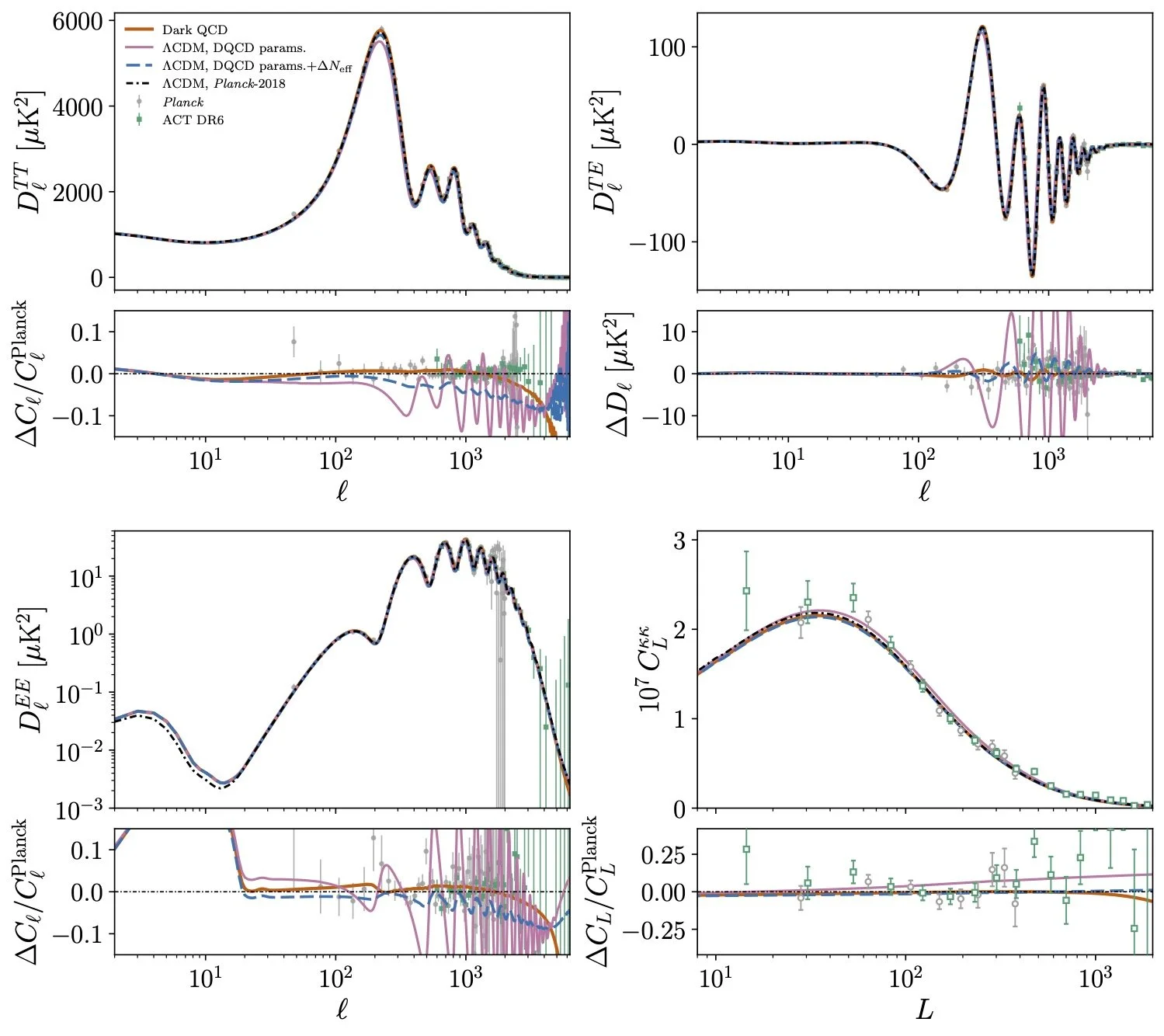
Comparison of the Planck data with the fits to LambdaCDM and the Dark QCD model. Key plots are the lower inset panels (the difference between data or model and the LambdaCDM best fit), where the orange-Red curve (Dark QCD best-fit) stays closer to zero than alternative models.
Our dark pions do neither. In addition to having a pressure, they have a viscosity. What this does is damp out the features of the dark radiation in the early Universe that usually cause problems for the detailed studies of the CMB. You can see this in the figure here. Most "normal" extra dark radiation models have oscillation features that are off from the data, whereas our model is much closer to the measurements. Another thing our dark radiation does is push on the dark matter a little bit: other models do this as well, but the exact way our radiation pressure dies off is sufficiently different that it allows us to do a few things different in the fitting to data than is typical.
Taking this viscous dark radiation, when we do a full fit to all the data available and vary the parameters of our model, we find that we can raise $H_0$ to $71.60\pm 0.63$ km/s/Mpc. This isn't the same as the SN1a measurement, which is even higher, and so we have a residual $3\sigma$ tension within the data. This is a generic feature of any solution to the Hubble Tension that modifies the early Universe. No one can get the early and late measures of $H_0$ to fully agree, and the "best" solutions that the community has come up with give about a $3\sigma$ remaining tension. So at least on that footing, this model is about as good as anyone has come up with.
Indeed, if you did manage to raise $H_0$ to the SH0ES value, you'd run into a potential new problem. Larger $H_0$, all else being equal, means a younger Universe. This is because the rate of expansion is higher, so for a Universe that has expanded in the same way, it has reached its present configuration "faster" which means it is overall younger. Our model predicts a Universe about 500 million years younger than the $\Lambda$CDM value. This doesn't make our model of the Universe younger than the oldest things we know are in it; but we are getting a bit close.
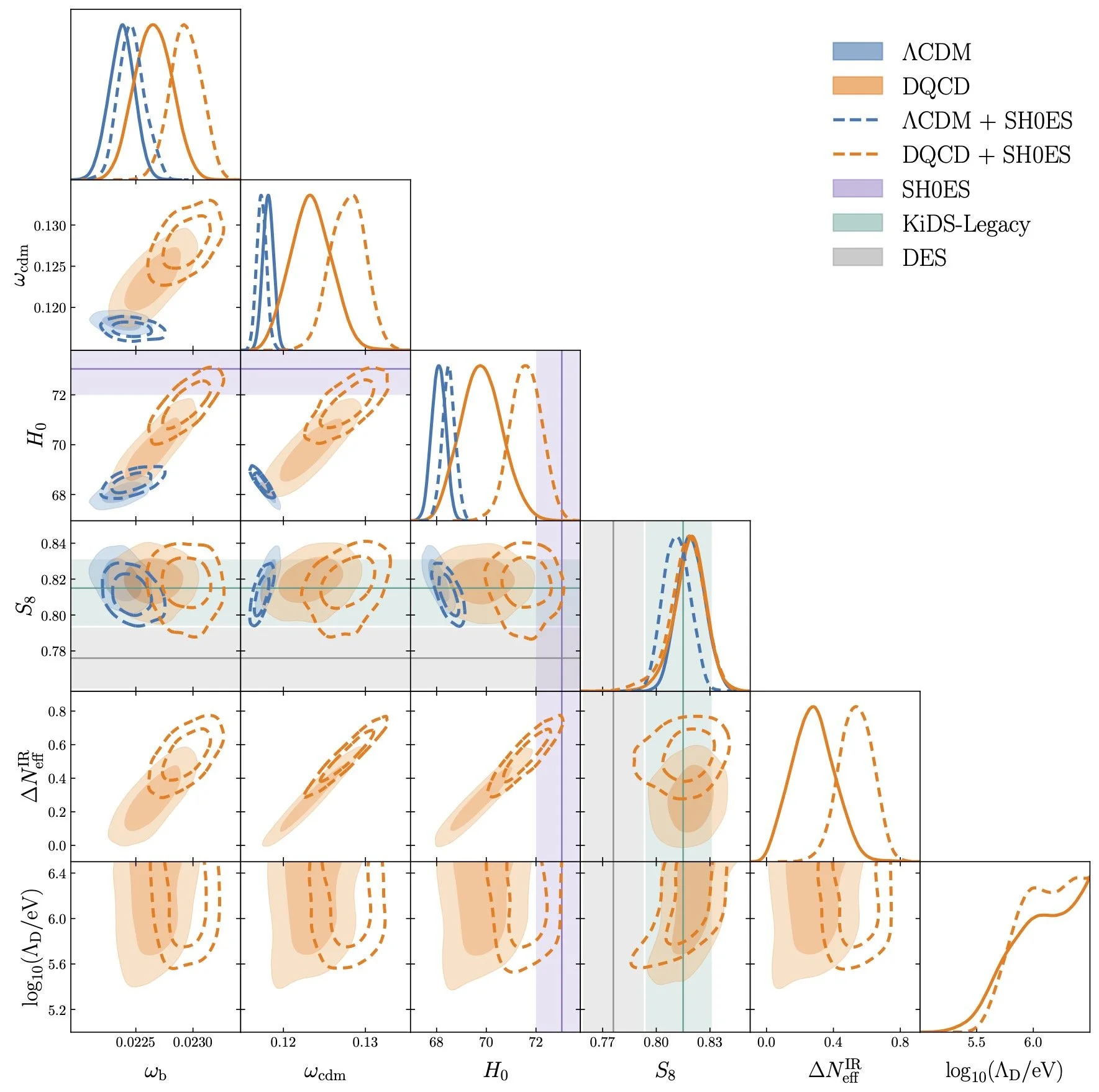
Corner plot showing the statistical fit of LambdaCDM (blue) and Dark QCD (orange) to the data, without the SH0ES data (solid) and with SH0ES (dotted). The Key plot is the H0 fit, where Dark QCD allows for larger H0 than LambdaCDM.
To fit the early Universe data, we want our dark QCD confinement scale to be around a MeV in energy (a factor of 1000 lower than the Standard Model QCD). The cosmological data are somewhat insensitive to the mass of the heavy dark quark, so we picked around 1000 GeV just for concreteness. Similarly, we picked structural parameters for the dark QCD that mirror the visible sector, mostly because I'm familiar with how the Standard Model works and why change it if we don't need to? But other choices of the gauge group or number of dark quarks would be possible.
One really interesting thing that happens when we fit the data that I didn't anticipate is that we also help with another tension that has cropped up of late. Those photon sound waves in the early Universe bake a particular length scale into the structure of galaxies, because the photons dragged a bit of matter along with them as they travel. As a result, the maximum distance a sound wave in the photon/electron plasma could have traveled by the production of the CMB corresponds to a length scale today where there are slightly more galaxies than otherwise would be expected. This is the "Baryon Acoustic Oscillation" (BAO) scale. We can measure it in the CMB, but we can also see it in studies of galaxies separated over hundreds of millions of lightyears in the "nearby" Universe.
What you measure in those studies of large scale structure is an angle: the ratio of the distance the sound wave travelled to the distance between us and the galaxies displaying the BAO correlation. When the DESI survey measured this angle, they found that it seemed to evolve over cosmic time differently than predicted in $\Lambda$CDM, if you assume the parameters that fit Planck data. This caused a lot of interest, because one way to solve the problem is to force the distance to the galaxies to evolve differently than in $\Lambda$CDM. You can do this if dark energy isn't a constant, but changes over time. The problem here as a theorist is that the data wants dark energy to spend some time increasing in density as the Universe increases. Dark energy is already weird, but this property is really weird. It's functionally impossible to write down a quantum field theory that allows this to happen. Even worse, if you did have such a material, you'd be able to create closed time-like curves. That is, such a form of energy is what is needed to build a time machine.
Don't get excited, if you can build a time machine you can reverse the increase of entropy and as we all know, you're not allowed to break the 2nd Law of Thermodynamics. Which is to say I don't believe this is a viable solution to the DESI BAO measurements.
Our model of dark QCD doesn't have anything that could be a time machine. But what it does do is fiddles a bit with the amount of dark matter and normal matter and dark energy you need to fit the Planck data. As a result, the Universe after the CMB evolves differently than in the standard $\Lambda$CDM scenario. Interestingly, this modification turns out to be a pretty good fit to the DESI data. It's not as good as the phantom dark energy build-a-time-machine model, but overall, quite a good fit.
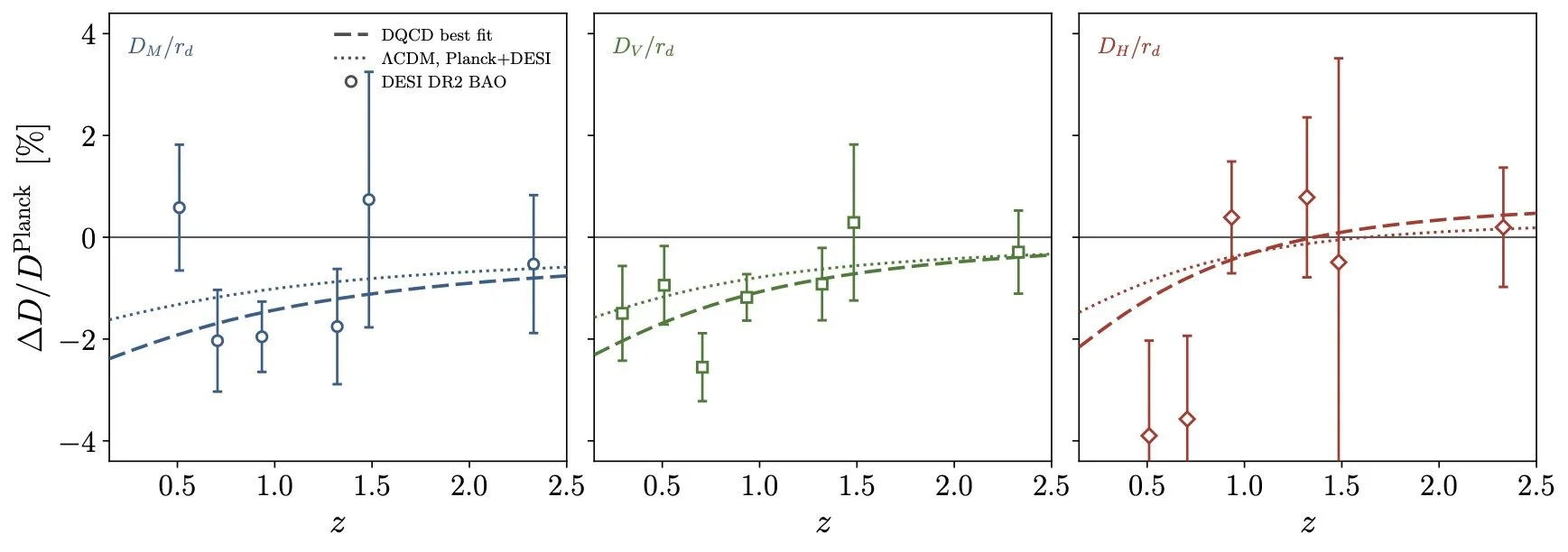
Residuals between the Planck-best fit and the DESI BAO measurements (sound horizon divided by distance measure). Important line is the dashed, which shows the fit of our model to the data.
One potential issue with this kind of model is that dark matter in the Universe today is going to be able to interact with itself, quite a lot. This is because today our dark matter still has this "muck" of dark QCD around itself, which would allow dark matter to bang into itself pretty often. We actually have constraints on how often this can happen, because if dark matter self-interacts, then energy can flow through the dark matter halo of galaxies and things will evolve differently than they seem to in our Universe. While our canonical model is marginally safe, it appears on the surface to be only marginally safe.
But it turns out we're very safe, and that's for a fun and interesting reason. The "big" cloud of dark QCD muck around the heavy dark quark creates a big cross section for a particle of dark matter to hit another particle of dark matter. But that turns out not to be what we care about. Most of those interactions would be between the low-energy dark QCD muck, not the heavy quark at the center. That core carries all the momentum of the dark matter, and so you need to really smash it very hard to get it to exchange much energy. So while it's "easy" to bang two dark matter particle together, it's difficult to get them to actually change their trajectory.
The analogy I'd use is that our dark matter is a bullet wrapped in tissue paper. The bullet (the heavy quark) is what needs to interact for something interesting to happen, but the bullet is small. So "hard" interactions are rare. The tissue paper can get torn to shreds passing through all the other bullets wrapped in their tissue paper, but that doesn't actually create an observable outcome for how a galaxy of dark matter evolves.
If you play with the numbers, it is fairly straightforward to create a model of dark matter charged under this dark QCD that eases the Hubble Tension, helps with DESI, and is insensitive to our studies today of self-interactions of dark matter. But you can also solve all those problems and end up with a model of dark matter that would have interesting behavior in the Universe today, slightly below the scales of objects we have good measurements more. The dark matter doesn't hit itself very often, but it does sometimes. The presence of the dark pions allows low-mass clouds of dark matter to cool, potentially causing high-density clumps of dark matter with no stars in them. So there are a number of interesting things that we can look for in the present-day Universe. Combined with a good-as-it-gets solution to the Hubble Tension, this is a model of dark matter physics that I'm actually kind of excited about.